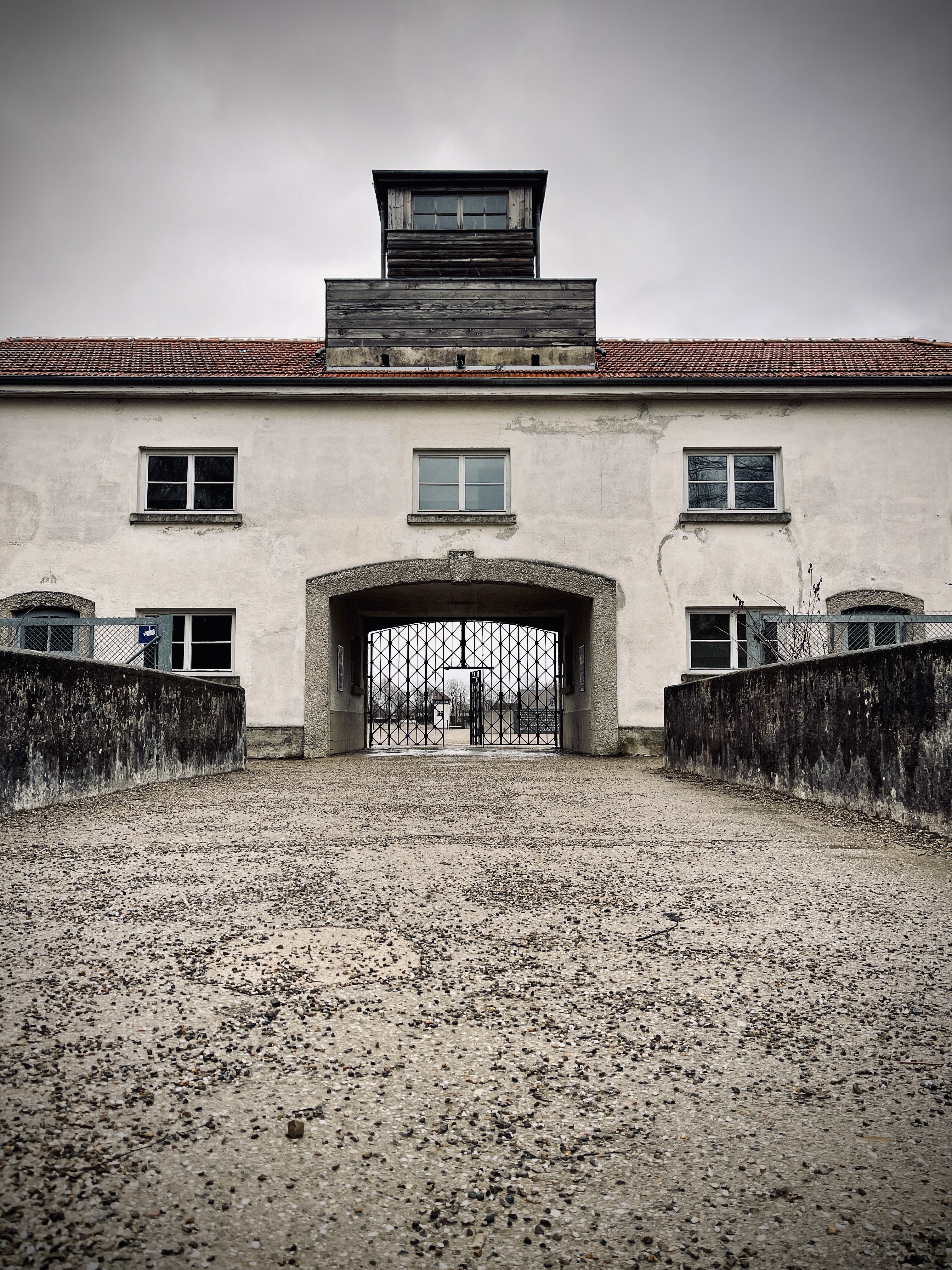
By nightfall on the last Sunday in April 1945, Marguerite Higgins had walked through the gate of Dachau before the infantry divisions sent to liberate it.
She was twenty-four years old, and she had been preparing for this day for years. She reached Europe in 1944 after persuading the Herald Tribune to send her, worked through London and Paris into the Berlin bureau, and by spring 1945 had attached herself to the advancing American forces with one ambition: to be present at the end. On April 29, 1945, that intention found her at the forward command post of Major General John Wilson “Iron Mike” O’Daniel of the 3rd Infantry Division, a short drive from the gates of Dachau. She was visibly unable to sit still.
She had already attempted to bargain with O’Daniel, who had refused her a spotter plane and had told her in plain terms, “Absolutely not. You’d be killed.” He was not wrong. She thanked him, left, and looked for another way.
Sergeant Peter Furst of Stars and Stripes would remember six decades later that Maggie came to him that morning at the army press camp “in army fatigues with a Russian helmet liner with fur and everything,” walked up to him, and asked if he wanted to work on getting this scoop together. Their advantage, she would explain, was that he had a jeep.
His jeep was the thing. A jeep meant she could move without a military minder tracking and blocking her every move. Furst was a combat reporter, German-born, fluent in three languages, and fast on his feet. When Maggie arrived, he had already been listening to a clandestine anti-Nazi German radio station broadcasting in his native tongue. The announcer had said the prisoners at Dachau rose the night before and took back their own enclosure, leaving the SS in the towers but cut off from the camp itself. Furst told Maggie. The two of them looked at each other and arrived at the same thought at the same moment.
He decided it was worth the risk. An American half-track driver who overheard them volunteered to lead the way through territory still held by the Germans. The three vehicles set off for the camp, the 42nd and 45th Infantry Divisions also moving toward it by separate routes that morning. The two reporters shared the same ambition: they needed to arrive there first.
Higgins was dressed for invisibility. Over her five-foot-eight frame, she had pulled on an oversized fur-lined German Army jacket she took in Weimar, the extra bulk of it erasing the line of her body. Layers of too-large fatigues finished the job. Her blonde curls disappeared under an all-encompassing Russian helmet liner, with goggles dropped over her eyes. She had understood that the further she vanished into obscurity, the more freedom she had to get her stories.
The jeep moved past clusters of armed Wehrmacht, still officially the enemy, yet already done with the war. Furst had stenciled Stars and Stripes across the front; an American flag fluttered from one side, and Higgins kept her breathing shallow as the soldiers stared. A single round struck the jeep, sharp and metallic, and they kept moving. In Furst’s later understatement, they were never really in danger.
In her memoir News Is a Singular Thing, Higgins would write that what frightened her most on that drive was not being shot but being blown up. German soldiers along the route surrendered their weapons into the back of the jeep, and the live grenades among the growing pile clanked together every time the wheels found a rut. Her body was in the jeep, braced. Cold air burned her exposed cheeks. The engine rattled through her boots. Her mind had already arrived at the camp.
She was not unprepared for what waited. Eighteen days earlier, on April 11, 1945, she had walked into Buchenwald almost as soon as it was opened. She knew what air thick with the dead smelled like. The American boys converging on Dachau that day were about to learn this stench for the first time, while Higgins was racing toward it.
In the cobblestoned town of Dachau, the resistance was light. A rumble of artillery, a few rounds of small arms fire, a tank slowly turned its turret to fire on a house from which someone had fired on it first. The house came apart with a single blast while white flags shuddered in doorways and windows of the surrounding buildings.
On the road, Higgins and Furst fell in with the convoy of Brigadier General Henning Linden, assistant divisional commander of the 42nd, with his aide Lieutenant William Cowling. Cowling told the reporters he did not believe American forces had reached the camp yet, but his orders were to do exactly that. Linden directed him to push toward Lieutenant Colonel Donald Downard’s 2nd Battalion of the 222nd Infantry, which would become the first of the 42nd’s men on the ground that day.
Higgins and Furst dropped in behind the lead jeep. They were inside the General’s column now, and Higgins was going to get through that gate.
What Higgins was moving toward had been operating in the service of the Third Reich for twelve years. On March 22, 1933, less than two months after Adolf Hitler became Reich Chancellor, Heinrich Himmler called a press conference to announce a new facility in the Bavarian town of Dachau, on the grounds of a former World War I munitions works. The facility, he assured the press, would hold political prisoners, restore order, and be operated with administrative professionalism.
The first deaths came almost immediately. The international press reported them. By May, English-language papers in the United States and Australia carried accounts of what was happening inside the camp. The world was not kept in the dark about Dachau. The world read about it, shuddered, and moved on, because in 1933 it was still possible to consider the camp an aberration.
Dachau was no aberration. It became the school that trained the SS administrators who would build and run the system that eventually stretched across occupied Europe. The classification of prisoners by colored triangles, the forced labor, and the operating procedures of dehumanization developed inside its walls became the process applied at every camp that followed.
In the early years, the prisoners were political opponents, communists, social democrats, trade unionists, journalists, priests, and anyone who had spoken against the regime. Then came the Jehovah’s Witnesses, the Roma, and the so-called asocials. After Kristallnacht in November 1938, eleven thousand Jewish men were sent to Dachau in a single wave. By 1945, approximately 190,000 people had passed through the camp, with at least 41,500 documented deaths inside its walls and sub-camps. The crematorium had run out of coal in late 1944 and could no longer keep up with the number of dead.
By the time the Americans approached the perimeter that Sunday afternoon, the dead were stacked in courtyards and railcars. The GIs in their open jeeps breathed it in and told themselves they must be near a large farm and a slaughterhouse. There was no other available explanation, until there was.
Before Linden’s party reached the camp gate, it reached the train.
According to Linden’s memorandum, the train ran along the rail siding bordering the camp. He counted between thirty and fifty cars, passenger, flatbed, boxcar, all full of the dead, twenty or thirty bodies to a car. Some bodies had spilled onto the ground beside the track. Every body bore evidence of starvation, beating, gunshot, or all three.
Sid Olson of Time-Life counted thirty-nine cars filled with dead, two of which contained, in his words, “fifty-three bodies in one car and sixty-four in another.” Most of the dead were naked, and most carried the marks of the lash on their backs.
The train had begun three weeks earlier at Buchenwald. More than five thousand prisoners had been loaded onto it on April 7 and sent south toward Bavaria as Allied forces closed in. Among them were a teenage boy named Ben Lesser and his cousin Isaac. By the time the train halted outside Dachau, most of the prisoners were dead in the cars. Lesser and Isaac crawled over the bodies to find water, which they drank out of puddles nearby. They were in the barracks when the Americans arrived. An American soldier, not yet understanding the impact of starvation on the survivors’ bodies, offered Isaac a tin of Spam. Isaac died in Ben Lesser’s arms within moments.
Lieutenant Colonel Donald Downard reached the train of the dead as the others did. He climbed onto one of the cars and lifted a lone survivor from among the piles of bodies.
Higgins, like the soldiers around her, saw the train before she saw the interior of the camp. The officers and reporters inspected the cars and bodies. Several, Cowling noted in his after-action report, had been shot through the head.
She stepped away from the train. Her body heaved and she was sick into the dirt. She wiped her mouth, placed her helmet back on her head, and walked back to the jeep. This moment encapsulated Higgins’s essence. She was not without feeling; she simply refused to let the feeling become an obstacle. The story was here, the story was now, and she was going to file it.
At the southwest corner, Higgins, Furst, and the General met three figures under a white flag: Victor Maurer, the Swiss Red Cross representative who had been inside the camp since the previous night negotiating its handover; SS Lieutenant Heinrich Wicker; and Wicker’s aide. Wicker was twenty-three, in command at Dachau only since the previous day, after the senior commanders fled.
He drew himself up, snapped off a Heil Hitler, and announced that he was prepared to surrender the camp and the prisoners inside, whom he referred to as criminals, and warned the Americans to be careful of them. The arrogance of the line and the arrogance of the man were too much after what they had just seen. Higgins slapped him hard across the face. Furst, beside her, watched. He translated. Wicker explained that the bulk of the SS garrison absconded with the previous commandant, and that the men who remained were at the machine guns in the towers. Linden’s memorandum recorded his reply: “Yes, I am Assistant Division Commander of the 42d Division and will accept the surrender of the camp in the name of the Rainbow Division for the American army.”
While the formalities continued, Higgins, Furst, and Cowling slipped away toward the prisoner enclosure. According to Higgins’s memoir, she stopped short when Furst pointed out a watchtower above her, crowded with armed SS and a machine gun trained directly on her. What she did next, she could not entirely account for afterward. The instinctive understanding she had in that moment, she wrote, was that there was no point at all in running. So she addressed the men in their own language. “Kommen Sie hier, bitte. Wir sind Amerikaner.”
Twenty-two SS men climbed down from the tower and laid down their weapons, by Higgins’s count. Conant’s biography puts the number at twenty. Either way, twenty-some armed SS soldiers in the towers of an SS concentration camp came down because a twenty-four-year-old American reporter told them to, in their own language, without a weapon in her hand. Cowling, beside her, had his.
Furst took the SS officer assigned to escort them, perched him on the hood of the jeep, cocked a pistol, and told Higgins to keep the muzzle on him. They drove on toward the inner enclosure.
Cowling took hold of the heavy wrought-iron gate with Arbeit Macht Frei worked into its bars and pulled it open. A man lay dead just past the threshold, shot through the head. Higgins would write that he had been killed by the SS the night before, while attempting to get out to meet the Americans the prisoners knew were coming. The German escort dismounted from the hood of the jeep and pushed the body to one side.
Cowling, his guard, and the two reporters walked through the gate. Cowling’s official report says he “opened the gate and entered the enclosure,” with the reporters entering “with” him. Cowling’s letter to his family the next day claims he was “the first American soldier to enter the famous Camp of Dachau,” a qualifier he himself added. Furst’s Stars and Stripes article names Higgins as “the first American to enter the crowded square inside the gate.” Higgins’s memoir and dispatch agree. Sid Olson cabled his editors the next morning what the second wave of correspondents had told him: Higgins and Furst “were actually the first to reach the central enclosure of Dachau prison.”
They were standing on the Appellplatz.
The great roll-call yard inside the gate was, in that first instant, empty of any human being. To the right stood the administration block. To the left, the entrance to the Lagerstrasse and the long lines of barracks. Above and beside them, the towers. The yard was empty because the prisoners had taken back their own enclosure the night before and were holding their lines deliberately, every man in his barrack, in case the SS in the towers needed only the smallest pretext to open fire.
A chilly wind moved across the Appellplatz. Nothing else did. The Americans stood still in their boots, feeling the towers above them.
The hush held for a minute and a half.
Then the question reached her, before any face did, called across two hundred yards from the barracks behind, in what she called “sixteen languages at once.”
Are you Americans?
She nodded.
The yard erupted.
People began pouring from the low barracks. Men with the red triangle of the political prisoner sewn onto their jackets recognized the typhus risk first and shouted in German at the surging crowd to keep back, that they were killing their liberators. Higgins and Furst were lifted off their feet and passed through the crowd. Higgins cried out that she could not breathe. One of the men who had hold of her, having taken her for an officer, let go when he heard her voice and called out in French, “This soldier is a woman!”
Higgins’s description, characteristic and dry, was that the man who first reached her was a coadjutor of Cardinal August Hlond, and was “not a little startled to discover that the helmeted, uniformed, begoggled individual he had so heartily embraced was not a man.” The hat shifted. The goggles came down. The blonde curls and rosy face appeared. The priest stammered his apologies, and she laughed.
Nerin Gun, the Turkish journalist held as a prisoner in the front row of the liberated, would write in his memoir of the same moment: “The officer was a woman, a war correspondent, Marguerite Higgins of the New York Herald Tribune.”
Furst’s Stars and Stripes dispatch named her as “the first American to enter the crowded square inside the gate,” and credited her separately as “the first person to announce to the prisoners that the Americans had arrived,” shouting the news in German, French, and English.
Sid Olson, entering moments behind them, was caught in the same surge. “There is nothing you can do when a lot of hysterical, unshaven, lice-bitten, half-drunk, typhus-infected men want to kiss you,” he would write. “It is no good trying to explain that you are only a correspondent.”
What Higgins saw inside, she would file in language that allowed the world to see Dachau through her eyes.
She wrote that the prisoner barracks held men dying of starvation in unbearable overcrowding, where twelve hundred men had been jammed into a space built for two hundred. The dead were laid out on the concrete walks outside the doors, three hundred having died of sickness the previous day, being carried out as she walked through. The mark of starvation was on every body she passed. Many of the men still living were so far reduced by hunger that it seemed impossible they were holding on. The air inside was thick with sickness and silence, with men too weak to speak above a whisper. Labored breathing was the loudest sound in the room. Higgins spoke with as many as she could.
The crematorium and what she called the torture chambers stood outside the prisoner enclosure, in a small wood. In front of the furnaces, hooks and pulleys had been mounted in the rafters, where the SS had hanged men by the neck or by the thumbs while their fellow prisoners were fed into the ovens, living or dead, on the timing and the appetite of whichever guard was on shift. On the wall, the SS had painted a mural of a headless officer in uniform, his SS insignia at the collar, astride a huge bloated pig and digging his spurs into its back. In the next room, an estimated twelve hundred bodies. In a ditch beyond, roughly two thousand more, dumped there in the last days by SS men too consumed with their own escape to feed them to the furnaces. The prisoners showed the reporters the place where the SS had brought men to be shot, kneeling. On the same spot a week earlier, they said, a French general, a resistance leader under de Gaulle, had been killed.
General Linden’s memorandum corroborated Higgins’s dispatch. The lasting picture he carried out, he wrote, was the camp’s systematic daily effort to degrade the human being to a point at which he was scarcely distinguishable from an animal.
A German Social Democrat, imprisoned eleven years, told them that on the slope above the camp lay six thousand graves from the years before the dying outpaced the labor of burial, and the great ovens were built to keep up. A committee of three Belgians said the SS had killed roughly two thousand inmates the night before, selective executions ending in indiscriminate machine-gun fire that continued through the early morning, as the sound of the American advance drew nearer. A Polish prisoner outside the crematorium displayed his right hand, the index finger sliced off at its base. He gave the only two syllables of explanation that were necessary. SS.
Somewhere in this, the SS guards, still armed in the towers, began firing into the surge of prisoners pressing against the wire. Soldiers from the 42nd opened fire on the SS positions and rounded up the remaining guards, while soldiers from the 45th lined up the SS in the coal yard, shooting many. Witness accounts place groups of SS men standing with their hands behind their heads, shot where they stood. A great many of the inmates approved.
Some prisoners who could clear the inner ditch ran out and fell on the bodies of the German guards, stripping them. Boots were the prize, and a few cut the feet from corpses to get the boots off faster. Linden held the gatehouse with his pistol drawn. The prisoners had typhus and could not yet be safely released. A captain of the 222nd Infantry fired his rifle into the air. Order returned shot by shot. While this was happening, Higgins moved through it all, taking notes.
Prisoners surged toward the perimeter. Some flung themselves onto the electrified strands of barbed wire. Higgins and Furst realized that the current was still on. Higgins took the camp loudspeaker and called out in German for calm, warning the prisoners that the wire was live. Furst went looking for the master switch. The power was cut, though several prisoners had died on the wire by the time it went cold.
The gate area became a crush. General Linden was working to keep his liberators, and the prisoners, alive. He found Higgins pinned against the wrought-iron grill, the mass of bodies behind her. He drove his hand through the bars and caught her. For several seconds she could not move or draw a breath, held between the gate and the men who had no idea they were crushing her. Cowling pulled her free. She shouted at the General that she had had her typhus shots, that she was doing her job, and that he should let her go.
And then she went back to work.
In her memoir, Higgins described a moment when a prisoner threw himself face-down in the dust at her feet. Her instinct was to seize him by the shoulders and drag him upright and shout at him, in German, that he should stand, that he should bear himself like a man. The camp had spent years grinding him into that gesture. She felt regret in the same moment she pulled him up, and knew the wrongness was hers, not his.
Nobody who walked into Dachau that day walked out of it untouched. Higgins included.
Inside, Father Erb, a 42nd Division chaplain, found his way to the priest barracks. He found fifteen members of his own religious order, including the priest who had ordained him in Vienna in 1933, twelve years earlier. He led them out himself.
Rabbi Eli Bohnen, the 42nd’s assistant chaplain, walked into the Jewish barracks and announced in Yiddish that he was an American rabbi. The men surged toward him and embraced him all at once. He wrote afterward that he had felt humbled and uncomfortable, because it was he, he believed, who should have been embracing them.
In the woods outside the perimeter, Private First Class Lockered “Bud” Gahs was on patrol. His squad had been told to watch for SS guards trying to escape in striped uniforms. A small group of men in stripes came rustling out of the trees toward him. Gahs knew they were not SS by their thinness and the dirt that covered them. They dropped to their knees and kissed his boots, weeping. Suddenly, the war and his role in it began to take a new shape.
First Lieutenant Jack Westbrook of the 222nd Infantry, sent to find Downard, walked the length of the train cars, located Downard, and was simultaneously sick on Downard’s boots. Downard moved quietly to one side in case the man needed to be sick again.
A chaplain climbed onto the back of a jeep, announced in stilted German that they would now pray, brothers, and continued in Latin. Some prisoners knelt. Others stood with their berets in their hands. Others wept without lifting their heads. Even the Russians prayed, making the sign of the cross as they watched the men beside them. The chaplain blessed the camp four times, once toward each of the four cardinal directions.
Higgins did not leave, though the deadline to file her scoop was passing. She had a list of names she had carried into the camp, and she would not file before she had answers to their fates. The names she would publish in her dispatch included the deposed French Premier Léon Blum and his wife; Kurt von Schuschnigg, Austrian Chancellor at the 1938 annexation; the anti-Nazi Lutheran pastor Martin Niemöller; Prince Friedrich Leopold of Prussia; Gabriel Piquet, Bishop of Saint-Étienne; Richard Schmitz, the previous mayor of Vienna; and Yakov Dzhugashvili, Stalin’s eldest son. An inmate told her the prominent hostages had been moved out several days earlier, deeper into Austria.
When she and Furst finally left, it was late, the roads were snarled, and by midnight they were still well short of the press center, the RCA transmitter had shut down for the day, and Higgins had missed her filing. She had kept stalling Furst inside the camp, telling him there was one more name to confirm, one more fact to confirm, one more prisoner to find. Furst told the same story differently, sixty-four years later. By the time they got back to the press camp, neither of them could sit down and put a hand to the typewriter. They were too undone to write. They had been “scooped” on Dachau, in his telling, because what they had seen had silenced them.
Both accounts are true.
They slept what little they could in the jeep on the shoulder of the autobahn as the war raced by them through the night. The next morning, instead of running for the transmitter, they detoured into Munich to watch the Seventh Army take the city in which Hitler had founded his movement.
The bulk of the 42nd did not stay at Dachau, except for a small group posted as guards. Munich was the prize, and the orders were to get the men there fast. By the next morning, the division was inside the city limits, and Munich fell. The birthplace of National Socialism. The prize. That same day, in Berlin, Hitler was dead.
The collapse of distance between Dachau and Munich within a single twenty-four-hour cycle is part of why so many of the men who walked through Dachau that day struggled afterward to find a place to put what they had seen. There was no pause in the orders, no protocol for processing it. The war needed to end. So they moved.
What they were carrying did not move at the same pace as their boots.
The men who walked into Dachau that afternoon learned slowly that the memories did not soften under the weight of years. Many of them spent the decades that followed making sure the record was kept accurately and completely. They understood that to witness creates an obligation.
Marguerite Higgins understood this, too. She had understood it at the train, when she wiped her mouth and refastened her helmet under her chin.
The Herald Tribune ran two front-page stories under Higgins’s byline. The Dachau dispatch was one of them. The headline ran across page one: 33,000 Dachau Captives Freed by 7th Army. The New York Newspaper Women’s Club gave her their prize for the best foreign correspondence of the year. The U.S. Army awarded her a campaign ribbon for her conduct during the surrender, on the recommendation of Brigadier General Linden, the same officer who had grabbed her through the bars of the Jourhaus gate to pull her out of the crush.
In eight weeks at the front, she filed a remarkable string of stories. Sid Olson wrote privately to his editors that Higgins had been “blitzing many tired old daily paper correspondents along the front with a steady trail of scoops.” She would go on to cover the Nuremberg trials, the Berlin blockade, the Korean War, and the Vietnam War. In Korea, after General Walton Walker ordered her out of the country, she appealed directly to General Douglas MacArthur, who reversed the order. In 1951 she received the Pulitzer Prize for International Reporting for her coverage of the Korean War, the first woman to win in that category.
On VE Day, May 8, 1945, she stood on a balcony at Schloss Klessheim near Salzburg and watched American artillery fire flares and tracer rounds into the night sky. According to Conant’s biography, she may have been the only person on that balcony who was not relieved that the fighting was over. From the moment she had come to Europe, she had wanted only one thing, and the one thing was now ending.
What she said about Dachau in the years that followed, again and again, was that it had been one of the most terrible and the most wonderful days of the war.
The liberation of Dachau was an accumulation of moments. A train of dead at the rail siding. A gate opening. A minute and a half of silence, then sixteen languages calling the same question across two hundred yards. A chaplain, finding the old man who had ordained him in Vienna. A rabbi, addressing the Jewish barracks in Yiddish. An American boy patrolling the perimeter, coming face to face with what this war had been. A chaplain blessing the camp toward each of the four cardinal directions of a world that was ending and beginning at the same time.
Among them, a young woman who had dressed that morning to disappear. Her hair hidden under a Russian helmet liner. Her body erased by an enemy’s coat. She had held her breathing shallow past the rifles of the Wehrmacht. She had been sick at the train. She had spoken to the SS in their own tongue. She had walked through a gate she would report to the world as being the first reporter through. She had slept on the shoulder of an autobahn that night because she had stayed too long inside a place she had refused to leave.
In the next two days, Lee Miller and Martha Gellhorn would also pass through the gates of Dachau. Higgins was first.
The war was fought by soldiers. The liberation of Dachau was witnessed for the rest of the world by a young correspondent who would not be told to wait outside it.
Three American units converged on Dachau in organized chaos: the 42nd “Rainbow” and the 45th “Thunderbird” Divisions, with elements of the 20th Armored. All had their own experiences. This article is based on the experience of Marguerite Higgins and the 42nd Division, with whom she was temporarily embedded on that day. A full accounting of all units and perspectives involved is beyond the scope of this article.