It is possible to know the narrow stretch of ground where a man was last seen and still not know where he is.
Eighty years and an ocean away, the document trail brings me into a frozen field west of Gambsheim, France, six hundred yards from the railroad station. There is no sound, and light begins to loosen the edges of the night. Cold from the snow-covered field comes through the soles of my boots. Six hundred yards ahead, beyond the open ground and drainage canals and the stark winter trees, is the station.
There is nowhere to hide on this flat, open field. A cluster of trees stands at the edge, and everywhere else the ground is bare. The soil is frozen, too hard for a shovel to make a foxhole; a soldier sent into this field cannot make himself invisible by burrowing into the earth. He must remain on its surface, and he must trust the darkness, his senses, the men beside him, and whatever mercy his fate may give him.
It is January 6, 1945. Company E of the 222nd Infantry Regiment has been trucked to this field, cold and sleepless, after spending the night on hardwood floors near Strasbourg. They belong to the 42nd “Rainbow” Division that has been in Europe for twenty-nine days, and most of the men have never seen combat. As they move into the field their breath swirls around them in slender white clouds. Like the trees, they are silhouettes, but they are in motion, whispers punctuated by the crunch of snow beneath their boots. They move in unison toward the railroad tracks in the last cover of dark before dawn, with no artillery to soften what lies ahead. They fix bayonets to their rifles, and two grenades dangle from each uniform. As one man from the company later stated, they were to count on the element of surprise. What a way to go out and fight tanks, he said.
Their mission: to take the town before the tank crews in the village can fight back. But the Germans hear them, and see them, coming. All at once, rifles crack and machine-gun fire comes from multiple directions, while streaks of tracer fire staccato the darkness. The cold air turns acrid with gunpowder and smoke.
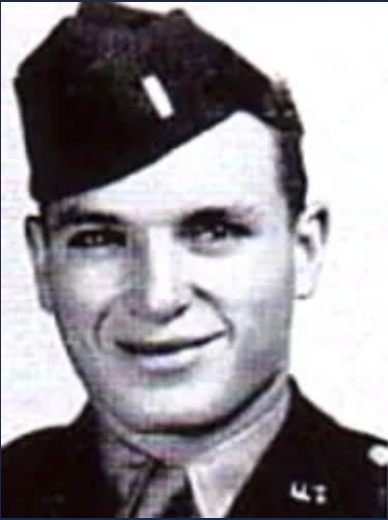
Second Lieutenant Dallas Bernard Hartwell, twenty-three years old, his brown hair covered by his helmet, stands tall in all of it, leading his men. His platoon is caught in the open. The only cover in sight is a wall next to a building. Hartwell decides his men can reach it if he holds the open ground while they go forward. German fire scatters across the field, searching the flat expanse for the incoming Rainbowmen.
Hartwell stays where his men can see him, all of his five feet and nine inches out in the open, in the snow-covered field, in the line of fire. He directs his platoon toward the wall and covers them with small-arms fire.
Then he is hit.
The words in his Silver Star citation do not describe how Lieutenant Hartwell defies the instinct in his muscles to fold down, over, and onto the earth. They do not contain the sound of bullets whizzing close enough to hear them or the sickening impact of shrapnel sinking into his flesh. They say only what he does: he gives his men a wall by standing where there is no wall for him.
The accounts agree that he is wounded, and badly, but disagree on details. The citation, written by his commanding officer, says he is carried toward the tracks. The medic who reaches him does not believe that he survives his wounds. Another man states that he dies where he falls. One man in his platoon sees the shrapnel tear his lieutenant so badly that he counts him dead in the field. Minutes later a shell hits and sends shrapnel flying. The blast caves in that soldier’s helmet and knocks him out cold.
The fight goes on without Hartwell. The radios have failed, so the company sends runners on foot to carry word back through the fire. The first runner goes down, and three of the next four go down after him. At dawn the men reach the railroad tracks and are pinned there by machine-gun crossfire, until rifle grenades break it open. They cross the tracks with rebel yells torn from frozen, ragged throats, take the station, and fight on into the village. Their ammunition runs low.
Five German tanks have roared awake, and the company has no rockets for their bazookas. Here comes a tank! a man of Company E recalls shouting. The tanks fire into the houses and explode glass, brick, and timber all around the soldiers. Their lungs fill with the wreckage, and cordite coats their tongues. Ordered to withdraw, they leave behind the dead, the men too badly wounded to carry, and the men who are out of reach and cannot be told that the company is pulling back. The men in the rear watch as the silhouettes of those they are leaving behind grow smaller.
By mid-morning on the 6th, Company E had been torn apart. Two officers and twenty-six men were dropped from the company rolls, a number not including the wounded. Six men were believed killed. The other twenty-two were taken prisoner by the Germans.
The company pulls into reserve. Their battalion commander, Lieutenant Colonel Donald E. Downard, brings his beaten company what comfort he can, with his officer’s ration of liquor, beer, cigarettes, and candy. He also brings music, and gets his men up on their feet, singing and dancing. The only quiet in the room belongs to the men they could not save in that field.
Before Dallas Hartwell leads his men through the field of fire, he is a boy on his father’s ranch in Wendell, Gooding County, Idaho, and one of four children born to Albert and Grace Hartwell. He works on his family’s land and enrolls at the University of Idaho at Moscow to study engineering. After joining ROTC, he is inducted by the Army, which eventually sends him to Camp Gruber, where he trains with the Rainbow. His brother Bert is a staff sergeant in the Pacific; the Hartwells have two sons in the Army.
At Box 65 in Wendell, a War Department telegram arrives. We regret to inform you. Bert is home on furlough, and Dallas is missing in action. The local newspaper runs an article: Infantry Officer Reported Missing. Albert and Grace are suspended between grief and hope. There are no answers that can tell them what exactly happened to their son, and his big brother Bert goes back to war.
After the field in Gambsheim, the boy from Idaho begins to move simultaneously through the Army as a name without a body, and a body without a name.
Soon, a letter from Major General Harry J. Collins arrives at Box 65. Dallas was wounded while defending a town in eastern France, given first aid and left for litter bearers. Missing does not necessarily mean lost, Collins writes. He asks the Hartwell family to hold hope that Wendell, Idaho, will soon receive its son.
The months pass, and the war ends. Prisoners in Europe are released and men begin to come home. Dallas does not write, and he does not come home, and nothing else arrives from the Army that can meet the hope that the Hartwell family has held these many months.
Grace writes to Washington, DC:
This silence is getting unbearable.
All the letters she sent to Dallas have come back, she says. She asks what happened to his identification bracelet, his ruby birthstone ring, his very fine fountain pen, and his camera. She asks for everything of his. It holds sentimental value, she says. She asks for the names and addresses of the boys who were with him, especially the sergeant of his platoon. She wants to speak to the last people who saw her son alive. She cannot yet know that his platoon, and all of Company E, took heavy losses on the same day she lost her boy.
The Army sends what it has. Hartwell’s uniform. Shoes. Cotton socks. A Zippo lighter. Private papers. The objects cross the country in his footlocker and arrive at Box 65 in Wendell. When she opens it, Grace’s fingertips move slowly over the mud on his shoes and the wool of his uniform. They bring him closer, and make him feel farther away. A mother knows her son’s eyes. What is not here is his camera, his blue eyes, and him.
His Silver Star citation tells Grace what her son did, but it cannot tell her who last held him, if he was held at all, or what happened to him after the Americans withdrew. It cannot tell her if he died with a medic frantically rushing to stop his bleeding, Stay with us Lieutenant, you’re going to be just fine, or if he died alone, in the field, a final breath sending a white puff into a freezing and empty sky.
The men who fell with him were lifted from that same ground and carried home, each one named by the tag found around his neck. That small piece of metal can be the difference between a name cut into a headstone and a name cut into the Tablets of the Missing at Epinal.
Hartwell’s dog tags were not with him.
The same frozen ground that would not yield for a foxhole opened nearly fifty years after the battle in Gambsheim. Dallas B. Hartwell. 2LT. O-550581. His dog tags were pulled out of the earth in France, cupped in a palm, slid into a pocket, and tucked away to wait for another thirty years.
The same commander who raised his battered company to their feet did not tuck his missing men away. Lieutenant Colonel Downard did not leave Hartwell on the battlefield, not entirely. In his papers is a tally of men he lost through the war, handwritten on a piece of brown Army paper. On the grid, his companies are stacked down the left column, and KIA, WIA, MIA are across the top. His family places this paper in my hands, with his story, during a visit to their home. When I leave their house, I carry Downard’s burden with me.
On the drive home and in my mind, Downard’s grid hangs in the headlights. The men tallied under MIA are there, underlined by the dotted white lines of the highway as they flash by. We should try to find the missing, I say. Downard and his men deserve the attention required to bring them home. At home in my archive, I begin to compile my own grid of the missing men who served under his command. Name. Serial number. Company. Date. Place of loss. Dallas Hartwell is one of those names. The list of Downard’s missing men grows beyond his battalion until it holds every Rainbow man who did not come home.
Within a month, the surfacing of Hartwell’s dog tags is brought to my attention. The timing shoots through me like electricity. I reach further into my archive and into the network I have built over years of this work for the records of his regiment, his own files, and the files of unknown Americans recovered around Gambsheim. The files begin to move between France and the United States. Hartwell’s family enters the search.
The wounded left behind, the dead, and the captured men had passed into German hands. Bodies were buried, sometimes alone, sometimes together, sometimes without names, and it was into this uncertainty that Hartwell disappeared. Army investigators had pieced together what they could, comparing his death file to the files of the unknown dead in the years after the battle. All they had to go on were physical clues left behind, such as dental charts and fingerprints, black whorls on a card in a drawer among thousands of drawers. Clerks processed his data and details in pile after pile of papers that did not line up enough to match his name to a body. Eventually, the Army declared his remains non-recoverable.
Among the records being examined again is the file of an unknown soldier the enemy had buried in a common grave near Gambsheim. The place, the day, and the circumstances are close enough to ask: is the unknown the same man as our missing lieutenant? Only science can answer this question; now, there is DNA that can help where files cannot.
The tags waited in the earth, then in a drawer. The grid waited in an old commander’s papers, kept by his family. The unknown’s file waited in a government vault, and the people who do this work carry the right records into the right hands. One voice can bring attention to a cold case. It takes a circle to bring a man home.
At Gambsheim the train station remains, pockmarked by battle, six hundred yards away from where he fell.
Wendell, Idaho, is farther still.
The earth held on to his dog tags for nearly fifty years.
It is holding on to him a little longer.
Dallas B. Hartwell remains unaccounted for. The Defense POW/MIA Accounting Agency currently classifies his case as Active Pursuit, meaning that sufficient information now exists to justify continued research, investigation, or possible recovery activity.
As of this writing in September 2026, no identification has been announced. He is one of twenty-nine Rainbowmen classified as still unaccounted for from World War II.