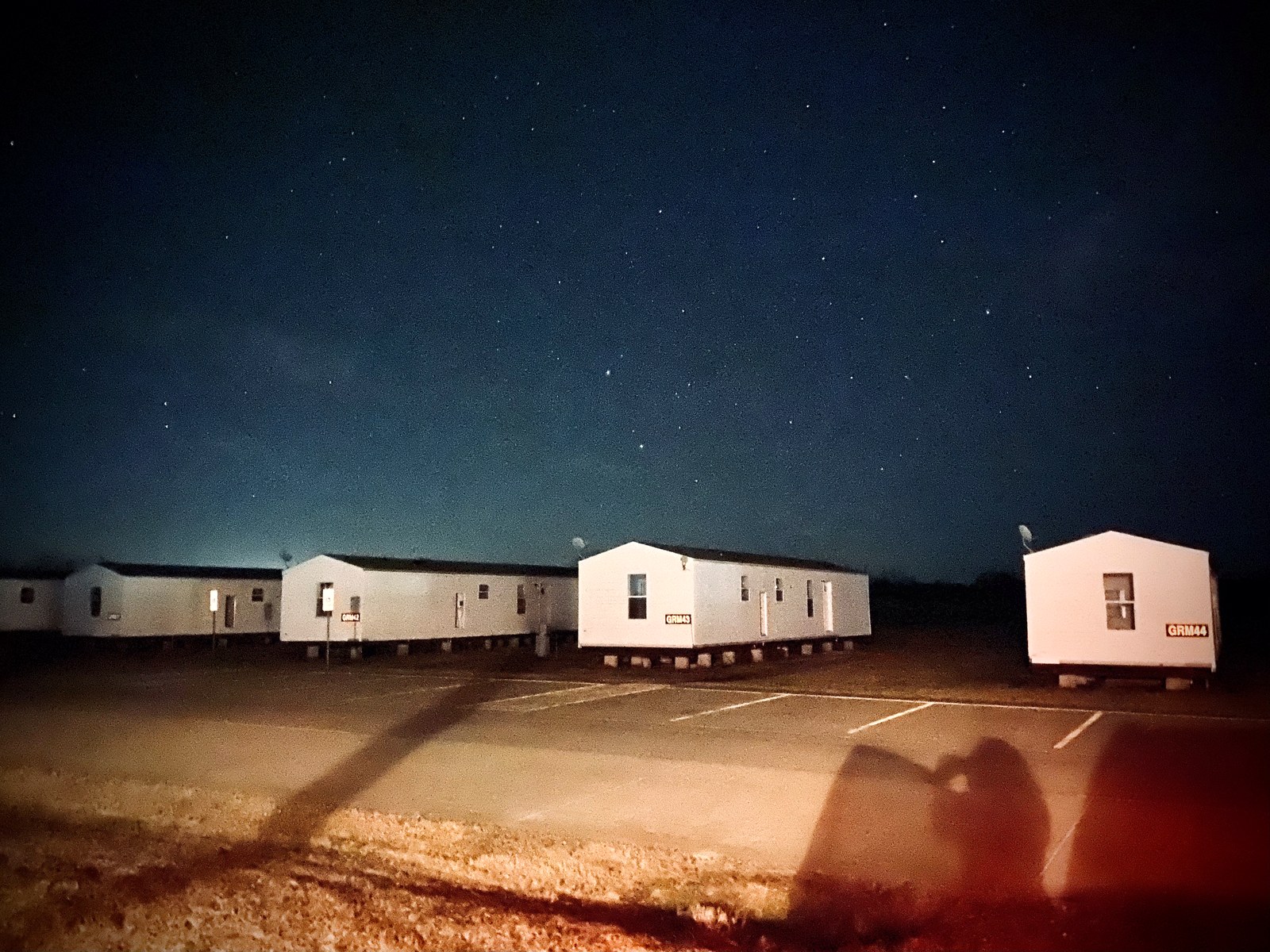
What I remember most about arriving is not the drive, or the gate, or paperwork being checked by military police under fluorescent light. It is the micro-moments that stay with me: my car climbing a hill, headlights cutting through swaths of trees and curving roads; the military base gate opening onto a vastness that, inexplicably, feels like home.
It replays again and again. I am stepping out of my car, the sound of my door closing lands sharply in the silence, a single note struck against something enormous and still.
Above me, the stars press down with a presence that has nothing to do with decoration. It is as if the sky itself were alive.
It feels less like looking up at the sky and more like stepping through a seam in time, as though this particular darkness has been holding itself open, waiting for my arrival.
The silence at Camp Gruber is not empty.
It has layers, residue, the accumulated weight of everything that happened here and was then abandoned to the grass and the weather and the slow indifference of decades. In the 1940s this was a small city rapidly constructed for war, a metropolis of preparation, with churches and theaters and barracks and motor pools, a parade ground wide enough to swallow thousands, baseball diamonds and artillery ranges and post offices and shops. Thousands upon thousands of bodies learning how to move together as one army, how to march in formation, how to aim and fire, how to kill or be killed, how to become what the world required whether they had asked or not.
None of it stands now. Even the men who marched here are mostly gone.
What remains are foundations, roads that go nowhere, ruins overtaken by grass and wildflower and the patient work of roots. The old entrance gate still stands, built by German prisoners of war. The vast parade ground sits open and empty. Soldiers once marched there in dust-covered formation, and President Franklin D. Roosevelt once stood before them, while the future hummed invisibly in their bones.
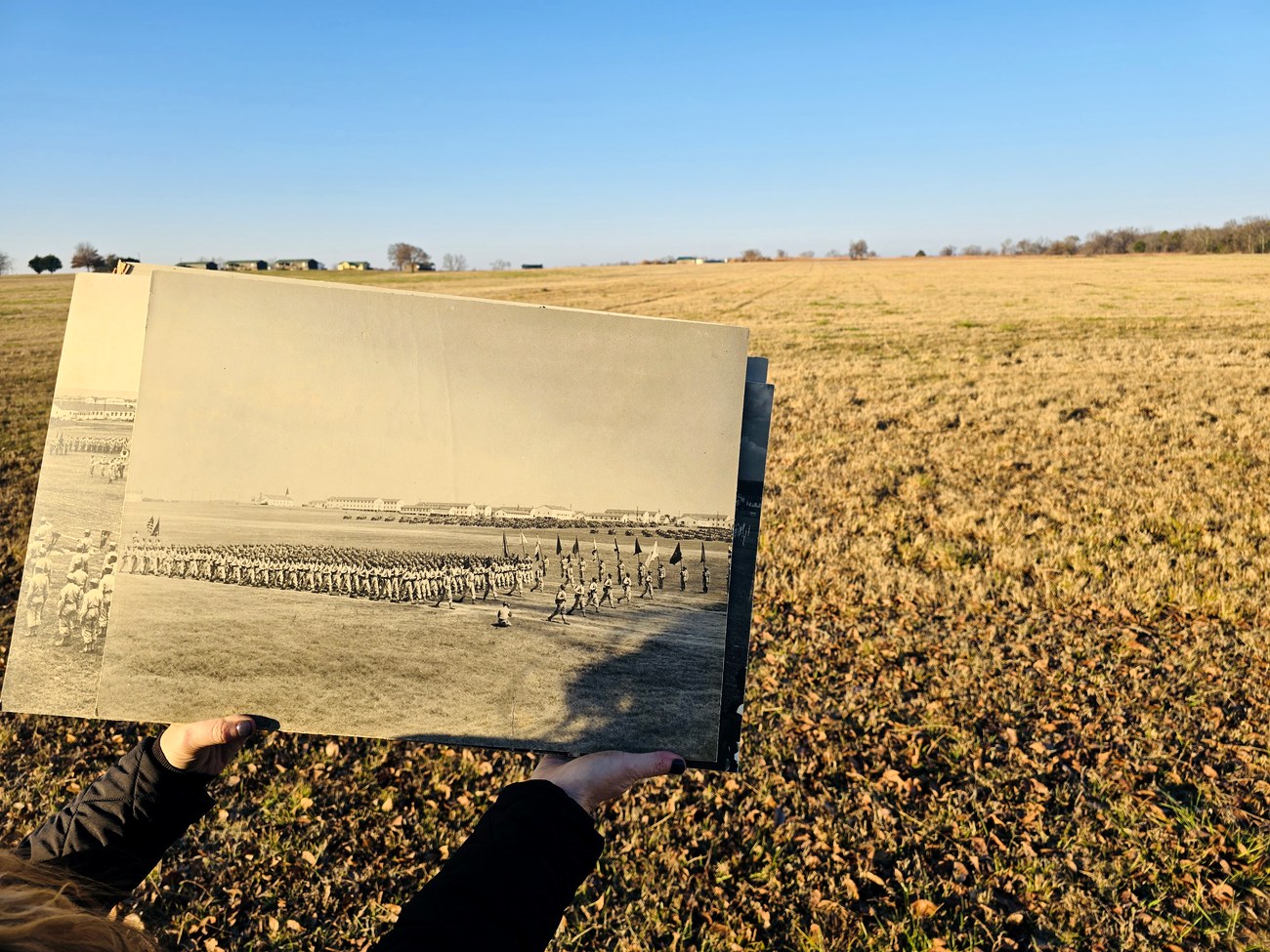
I have been to Gruber in every season, and every season the land gives me something different, and yields something it has been keeping.
Winter strips it bare, and the cold bites into you, bone-deep, and makes silence absolute.
Spring softens the ruins into something elegiac, green pushing up through cracked concrete, wildflowers threading through old foundations.
Summer brings the same Oklahoma sun that baked these men on the parade ground, the sun still thick and merciless. Standing in it you understand what it cost them to train in this heat, in full uniform, with guns, ammo, and whatever else they carried.
Autumn turns the Cookson Hills amber and rust. The streams trickle, the birds caw, and the storms roll in, electric.
I return again and again because the landscape changes with the seasons, and what can be seen and felt changes with the weather.
I take a turn to the left onto a dusty road and see a long berm rising from the earth. The wind carries cold air across an open stretch of land that seems to go on forever in every direction. It is impossible not to imagine the sound that once lived here: boots striking dirt, rifles cracking in sequence, voices calling distances across the field, targets rising and falling in the pits below. Laughter, shouts of frustration and celebration, officers barking orders. It is still in the atmosphere. The dust still lifts when you walk, still catches the light the same way it must have caught it then.
In the summer of 1944 a young soldier sat here and wrote a letter home to his brother on a piece of the perforated target paper. It included a drawing of the berm, the trees, the guns, and the men aiming them. That letter and its drawing still exist, and show us the scene as seen through a young private’s eyes.
The target I lift does not belong to World War II. It remains from a later period of training on the same range, after another generation of soldiers came to Gruber and practiced the same measured act.
Deep in the concrete belly of the furthest berm, there are targets that have been used to practice long-distance firing, paper silhouettes riddled with holes, and around each puncture fine cobwebs cling with a delicacy that seems almost deliberate, as if time itself has been weaving quietly through violence, making something intricate out of force.
I hold one upright, my body aligned with the paper silhouette that was created for the purpose of destruction. My hair crackles with static from the cold, or from decades colliding, or from something that has no name. My living body meets the object that was made to rehearse the ending of one.
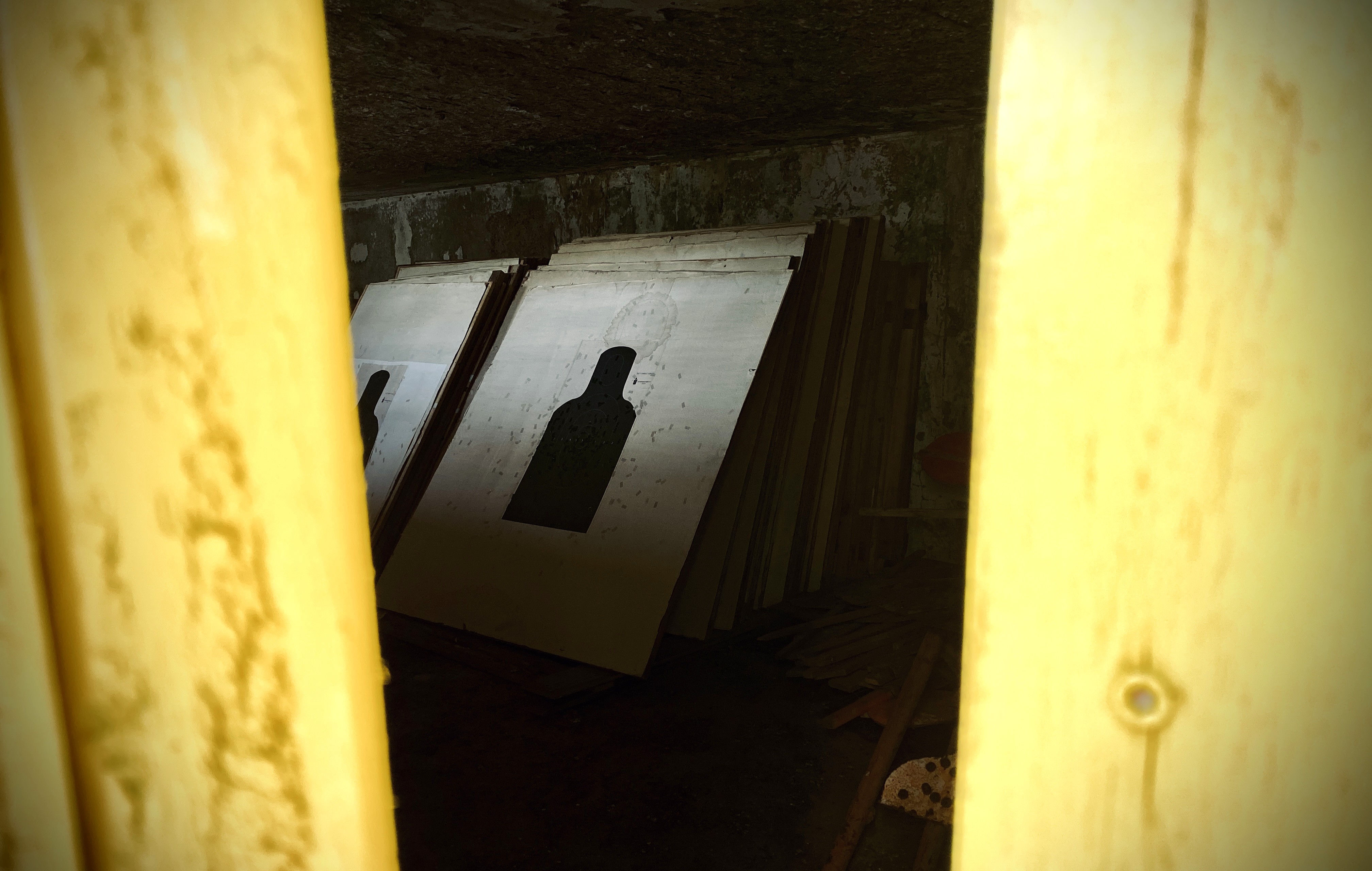
At the center of the target, someone has drawn faint pencil lines connecting seven of the holes, as if searching for pattern in the random distribution of impact, as if the act of mapping violence might reveal something that the violence itself could not.
In that moment, the bullet holes become a constellation.
I think of Orion, with his hot belt of stars nestled together. Then his shoulders, the lifted arm, the bent knee. Four thousand years ago in Mesopotamia he was already there, not yet called Orion, a warrior placed among the fixed lights. He was a body mapped in fire, carrying a weapon, pursuing and pursued, rising each winter over fields where men were learning, as they are here, how to aim their fire, to protect, hunt, and kill. Visible to the naked eye and known for millennia, viewed by Galileo through his telescope, navigated by sailors and farmers and soldiers across every war the world has ever made.
Every war trains people to measure distance.
Every sky teaches people how small that distance is.
The stars burn over the training ground and the war with equal indifference. Here at Gruber men lay themselves at the mercy of the celestial and the catastrophic.
I photograph the target from every angle, trying to make the image carry what the moment contains. I stand with the target pressed against my body and feel the charge of it: the static electricity, the strange doubling of myself and the silhouette, the living and the designated, the one who breathes and the one who exists to be struck.
The silhouette has no face, and this anonymity is not accidental. The system that put these men here did not have a face, either. Many of the men did not choose this range, this berm, this target. A notice arrived, a number was assigned, and the machinery of war moved them across the country and across the ocean with the same impersonal efficiency with which it moved ammunition and equipment.
The abstraction of the draft mirrors the abstraction of the target: you cannot send a person to war, so you send a soldier; you cannot shoot a person, so you shoot a silhouette. The system requires the removal of the face before it can proceed, and it is very good at this removal, and it has always been.
In the dimly lit belly of the berm, in the dark, I count. There are approximately 126 bullet holes in the target, a constellation of force pressed into paper at impossible speed, a map of will and training and the vast systems large enough to pull entire worlds into war, of men being shot and captured and wounded and erased and, if we do our work, remembered.
Families bend around these holes. History bends. What survives is shaped forever by what passed through it, and what passed through here was the full weight of a generation that did not ask for what was asked of them.
We are made of stardust, after all. Forty percent of the elements in the human body were forged in stars billions of years ago, in the same furnaces that made the iron in the bullets and the calcium in the bones they passed through. War and stars have always shared the same sky.
During the war, the stars would have rotated over this berm night after night, indifferent and magnificent, the same stars that have always presided over human suffering without comment. On one side of the road: American infantrymen in training, staring upward in the brief reprieve before sleep, imagining sweethearts left behind, bracing for a war they had not started and in many cases had not chosen, carrying the particular dread of men who know they are being prepared for something they cannot yet imagine.
On the other side of the road, separated by wire and the entire moral architecture of the conflict: German prisoners of war, already carrying the knowledge of combat and capture, already living inside the aftermath of the same war, already knowing what the American does not yet know.
The historical irony is almost unbearable. The American trains here to fight the German. The German is already here, already defeated, already building the paths the American will walk. They pass one another in the ordinary course of the day. They work alongside one another. Neither fully knows what the other knows. The American does not yet know what the front looks like, what it smells like, what it does to a man to be inside it.
The German cannot forget.
Yet they were moved by the same enormous, faceless machinery, from opposite directions, to the same patch of Oklahoma ground, under the same stars, inside a world at war with itself.
This is what I mean when I say time overlaps.
The land has always known this. It holds every moment that has ever occurred within it, simultaneously, in a stillness that is not emptiness but fullness. The soldiers arriving in 1943, the prisoners building in 1944, the base deconstructed and then revived, my own footsteps now in every season, year after year, all of it present, all of it resonating in the same chord.
This is the work: to come to the land and let it give up what it has been holding. To stand in the cold and the heat and the amber light of autumn and the green insistence of spring, until the silence opens and the residue rises and the time that has been waiting in stillness begins, finally, to move again. To be the one who gathers, the artifacts, the echoes, the lives that the land has held for decades, patient and faithful, waiting for someone willing to receive them.
I remain inside the berm until my eyes have grown accustomed to its darkness and the target no longer feels like something I have discovered. It is simply there in my hands, damaged and anonymous, carrying the record of force without the name of anyone who fired it.
Then I lower it carefully and return it to the others. I move through the narrow opening and step back into the cold. Wind crosses the field. Dust catches briefly in the light.
Behind me, inside the concrete dark, seven bullet holes remain joined by pencil inside the outline of a human body.
It is a jagged yet peaceful truth, this way of standing in the field with the dead. But it is the only truth I trust.