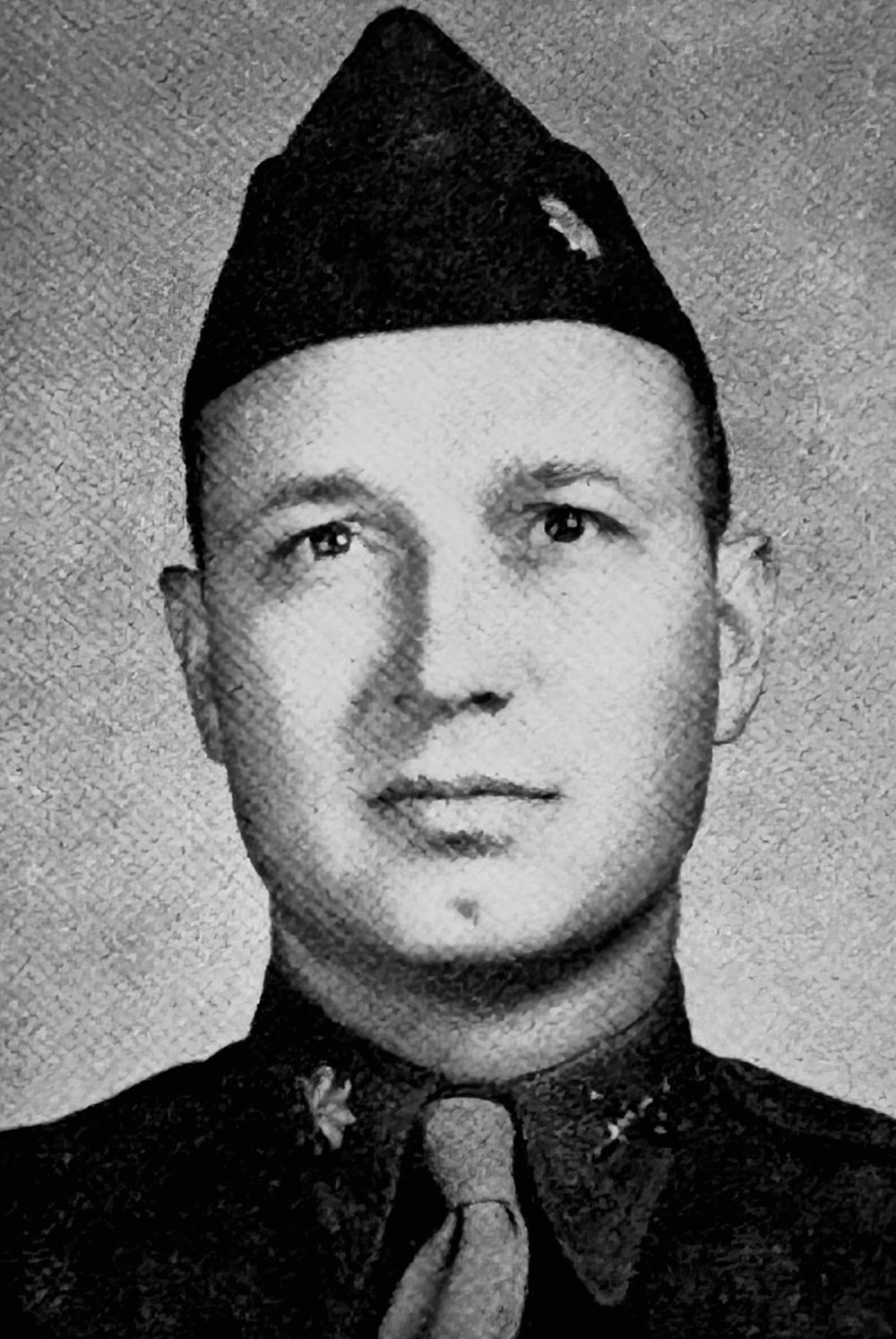
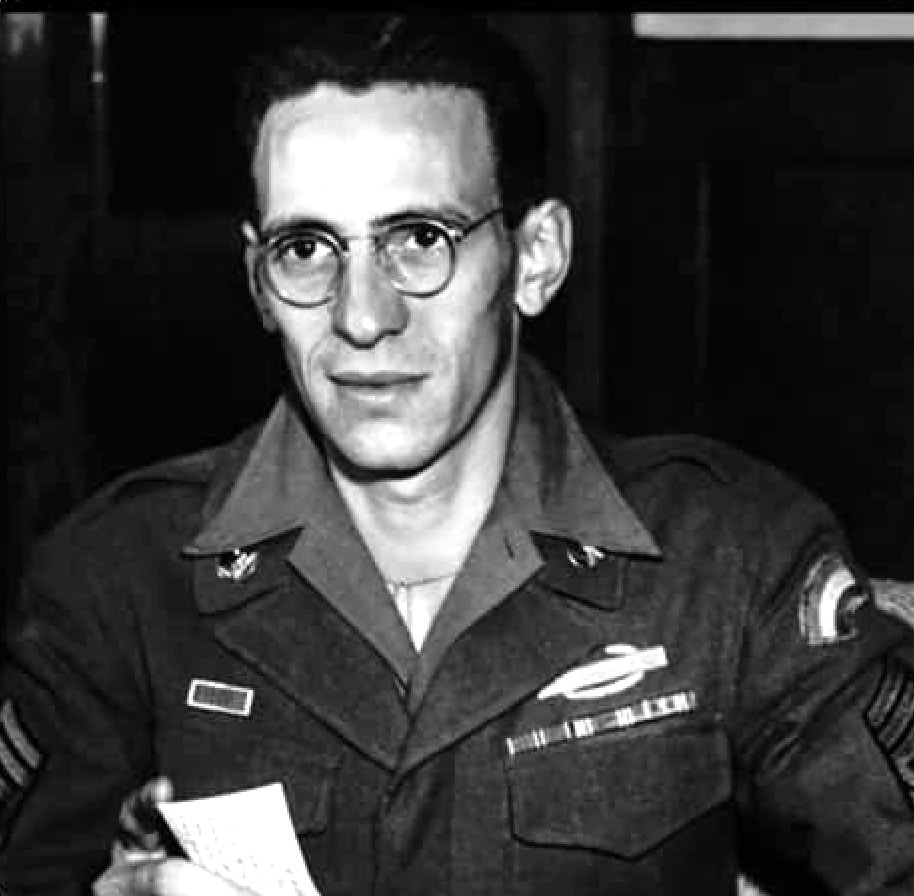
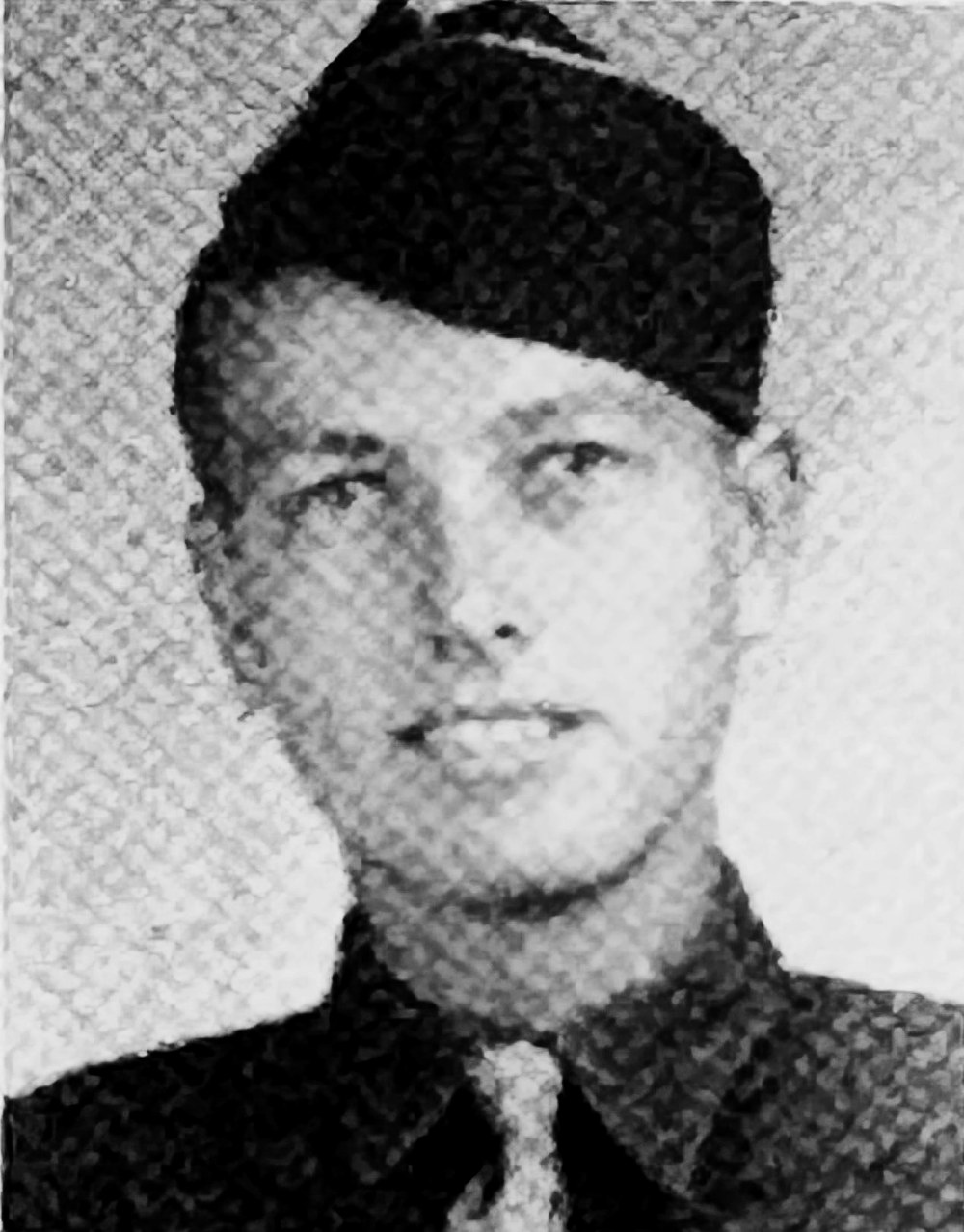
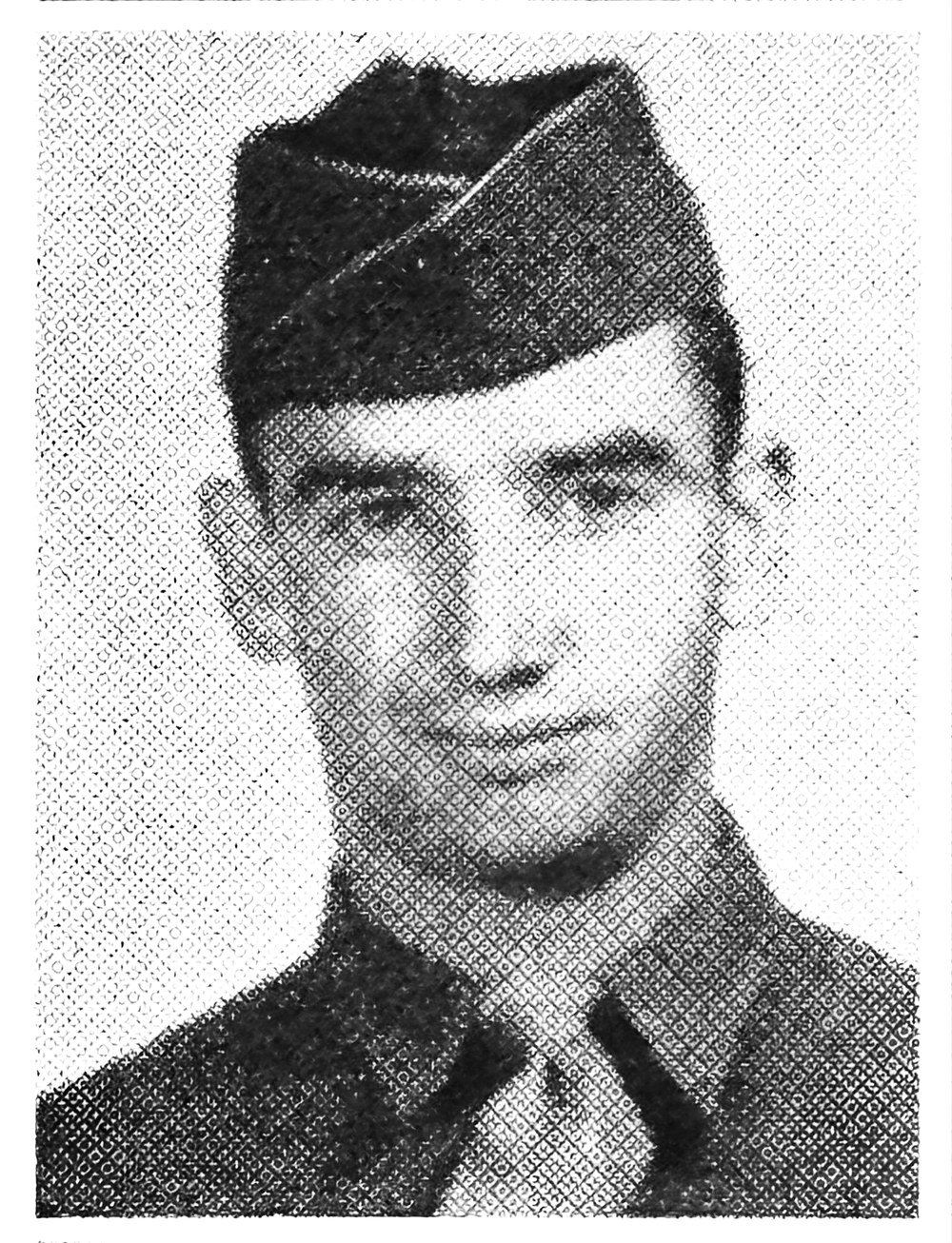
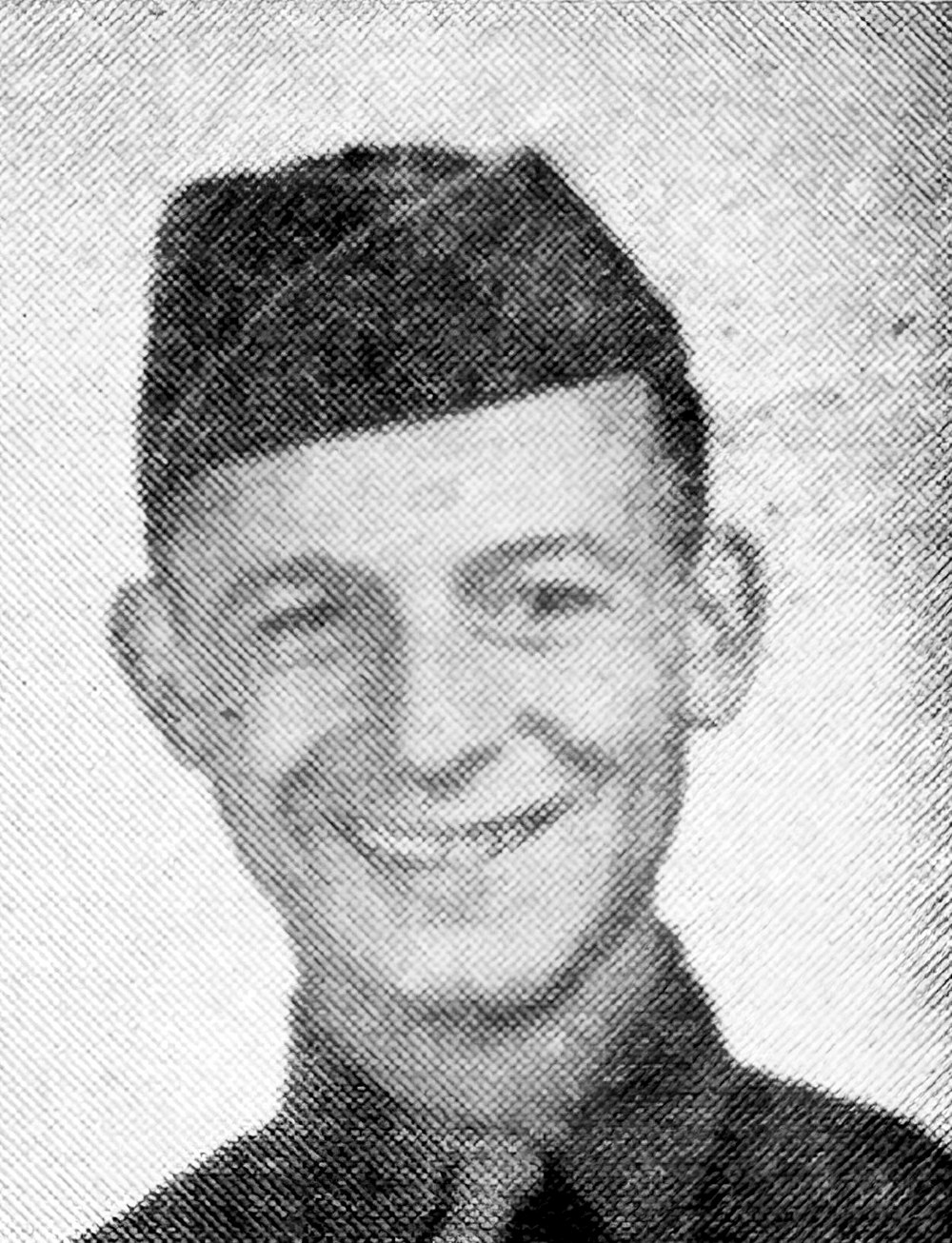
Written at the request of the Rainbow Division Veterans Foundation, these are the men behind the casualty figures at Hatten. In January 1945, the 1st Battalion of the 242nd Infantry Regiment held the frozen villages of Hatten and Rittershoffen against flame-throwing tanks and crack troops fresh from the Soviet front. Lieutenant Colonel Edwin Rusteberg took thirty-three officers and seven hundred forty-eight enlisted men into the line. Fewer than half walked out. The Foundation asked for these portraits so the numbers would carry names again, part of the effort to keep the battlefield itself from being lost to a lithium mine.
Where the Malgré-nous had been forced into German uniforms against their will. Where the families of Hatten and Rittershoffen have spent eighty years rebuilding what was taken away. One history. Held by all of us.
Lieutenant Colonel Edwin Rusteberg is walking the line at Hatten.
He is thirty-three years old, from a small town in Texas, on the border of Mexico by the gulf, and the cold of Alsace is a cold his body has never known. The ground is frozen so hard the men cannot dig. The Maginot pillboxes sit low against the snow, their concrete cupolas dusted white, the embrasures looking out over fields where nothing is moving yet.
He stops at each position. He knows their names. He knows which sergeants are in which pillboxes, and which lieutenants are holding which intersections. He knows Wells. He knows McBride. He knows Cahoon. He knows Schmidt and Waters and Bertoldo and Brucker.
He stops at the position of Sergeant Cahoon, third platoon. Sergeant Cahoon, he says, you have good positions here. Cahoon, who has been in the cold for hours, respectfully disagrees. The Germans, he tells the Colonel, will figure the line should tie to the Maginot pillboxes, and the line should be elsewhere. The Colonel cuts him off. Well, I have established this MLR, and it will stand any attack by the Germans.
Cahoon salutes. Yes, sir.
The line is the Colonel’s. It runs four thousand yards, north and south, through the village of Hatten, anchored on nine pillboxes of the old Maginot Line. It is the Colonel’s because he drew it. It is the Colonel’s because every man on it is there because the Colonel put him there. The line will stand or it will not stand on what the Colonel does next, as well as the men who stand with him.
The German patrols start coming. Then the artillery falls on the village. The white-caped infantry are climbing onto the pillboxes and firing down into the foxholes on the MLR.
Radio silence is broken. The voices of his men pour in. He is in the cellar of the battalion command post with his staff. The cellar is below a building on the main street of Hatten. The walls of the cellar are damp stone. The air smells of cordite, of cold mud, of men who have not slept, of the burnt iron of the radio’s tubes. The radio is on the table. Eight parties are on the line at once and the Colonel is taking them all.
Lt. Schanck, “B” Company. Four enemy tanks moving west toward Pillbox 1. Five more at the woodline.
1st Sgt. Troy, “C” Company. All officers down. Repeat. All officers down.
The Colonel gives the order. Lt. Ivey to the troops. Take charge of the company.
A tank commander from the 14th Armored comes down into the cellar. He tells the Colonel he can bring his tanks in to support the line, and he and the Colonel work out where the armor will come from and how it will roll.
The men around the radio table feel it.
The Colonel’s got tanks coming.
The tank commander leaves the cellar to bring his armor up.
Somewhere up the chain in a building where no one has plaster falling onto their map, the order has been countermanded.
No one tells the Colonel.
He is on the radio giving orders that depend on tanks that are not coming.
The tanks do not come.
The 88mm shells are coming through the cellar window from a tank that has parked itself in the street thirty feet from the doorway. The tank is too close for the bazooka teams to angle on it, and the bazooka teams sent out by the Colonel earlier never come back. The tank fires, reloads, fires, reloads. Each round shakes plaster from the cellar ceiling onto the table where the radio sits. The switchboard operator takes a shell fragment and is replaced.
Outside, the buildings of Hatten are burning. Inside the buildings, in the cellars beneath them, the families of the village are huddled in the dark with their children. The Colonel knows they are there. The Germans know they are there.
The Colonel is transfixed on the radio, and it is transfixed upon him.
The Colonel keeps his voice level. Three thousand miles from the cellar, his wife is at home with their daughter. Suellen is one year old. He does not let himself think of her. If he thinks of her his voice will shake.
The men on the other end of the radio cannot see him, but they can hear his voice, and what they hear is what they will do next. He knows this. He has known this since West Point.
A battalion commander’s voice on the radio is the battalion’s nervous system.
If his voice shakes, the line shakes.
The line does not shake.
His rifle companies want orders as the German tanks roll past their pillboxes. His answer comes back:
Hold your positions. Let the tanks pass. Fire at the foot troops.
They hold.
The cellar is the only place in the world. The radio handset is slick in his palm and he wipes his hand on his trousers and takes the next call. His mouth is dry. The plaster dust coats his teeth. His staff officers sleep in fifteen-minute shifts against the cold stone of the cellar wall and wake when their shoulders start to fall and take the radio so the Colonel can close his eyes for a minute, and he does, and his eyes open again because the radio is calling for him.
They stick it out for fifty-two hours.
On the morning of January 11, the men leave the cellar in groups of three. He walks out with what is left of the battalion he brought in.
Colonel Rusteberg walks out through what is left of three hundred and fifty houses, nearly all of them damaged.
He took 33 officers and 748 enlisted men into Hatten. 11 officers and 253 enlisted men walked out. The rest were killed, wounded, or missing.
He never speaks of it again.
The line the Colonel held at Hatten holds, still.
What follows are stories of the village the Colonel held and the men who held it with him.
•
Master Sergeant Vito R. Bertoldo
Company A, 242nd Infantry Regiment
The Cook Who Fights to Fight
The night before the tanks come to Hatten, the battalion clerk teases him about his bragging. Bertoldo has been telling everyone what he will do when he gets a crack at the Germans. The clerk tells him he will be the first man into a foxhole and they will not see him again until the fighting is over.
Vito Bertoldo is a coal miner who cannot see well enough to be a soldier. The Army tells him so. When he tries to enlist in 1942, the recruiter rejects him for poor eyesight. Limited duty only. They clear him as a military policeman in the United States, the kind of safe stateside posting men get when their eyes or their hearts or their flat feet keep them out of the line. He does not accept this. The war is happening without him, so he talks his way into infantry training. After all of that, he lands in the Rainbow Division as a cook.
He cannot get along with the mess sergeant.
His company commander considers him Company A’s only discipline problem. He wants out of the kitchen. So when battalion headquarters asks each rifle company to send three men up to stand guard duty at the 1st Battalion command post in a small Alsatian village in early January 1945, Captain Corson sees his chance to solve a personnel problem and puts Bertoldo’s name on the list.
That is how the cook who fought to enlist, who fought to be an infantryman, and who fought with his own mess sergeant comes to be standing at the entrance of a stone house in Hatten when the German tanks come up the street.
The first shells come in at first light.
The battalion staff withdraws to the basement to set up the alternate command center. Bertoldo does not go with them. Without orders, without a word from anyone, he picks up a light .30 caliber machine gun, walks out into the street, and sets it up at the entrance of the building. Shells burst within a few yards of him. He fires.
For the next forty-eight hours he does not stop.
When the building is shelled top to bottom, he goes inside. He finds a table in the front room. He drags it to the window. He lifts the .30 caliber machine gun onto the table and ties it down. The cook strapping the gun to a table the way you would strap meat to a butcher’s block. He sights through the window. A tank is parked seventy-five yards away in the street. He fires.
A shell blasts him across the room. He goes back to the gun.
When the command post has to be moved, he stays behind to cover the withdrawal. When the second command post has to be evacuated, he stays again. When a tank fifty yards away destroys his machine gun, he picks up a rifle. Someone passes a bazooka through the door. Bertoldo knocks out a tank.
He comes out of the room covered with plaster, laughing, and says:
I told you when I met those Germans, I would teach them how to fight.
Then it is over.
The man who held the line writes the citation. Lieutenant Colonel Rusteberg sits down and puts what he has watched into words.
By his extraordinary courage, Private Bertoldo saved two battalion headquarters from destruction and the personnel from death or capture.
The Colonel sends it up the chain.
President Truman places the Medal of Honor around his neck at the White House on December 18, 1945.
After the war, Bertoldo works for the Veterans Administration, helping disabled and homeless veterans who are denied the benefits they are owed.
The cook who could not see well enough to be a soldier, who fought to enlist, who fought his mess sergeant, who fought forty-eight hours alone in a stone house in Hatten and killed forty Germans and laughed through plaster afterward is forty-nine years old when he dies.
•
PFC Glenn E. Schmidt
Company A, 242nd Infantry Regiment
It Shall Not Come Near You
Glenn’s son Lonnie is only weeks old, and Glenn has never seen his face.
He walks into a bunker on January 9, 1945 with his wedding ring, a pocket knife, and a New Testament. A glow of candles lights the Christmas mail that has just arrived. Glenn opens a letter from his father, and squints to read by candlelight the quote from Psalm 91: A thousand may fall at your side, and ten thousand at your right hand; but it shall not come near you. He folds the letter and puts it in his pocket. His father has sensed something across an ocean.
It is two in the morning and time for a patrol. Glenn asks the fellows for a moment of prayer. They take off their helmets and gather in a circle of moving shadows cast by the flickering light. Glenn prays for protection in what is to come.
Ten men step out into the night, led by PFC Harold L. Finley. Glenn is the second man, walking directly behind Finley with his Browning Automatic Rifle, to cross a little bridge and reestablish a listening post in front of Pillbox Number 9.
The snow is twelve inches deep. A burning village lights up Glenn and his men, their olive drab uniforms easy to see against the falling snow. The Germans are invisible in winter camouflage. They see Glenn coming.
A German voice calls out from the dark, but Glenn does not answer.
Then the Germans are everywhere, all up and down the creek, voices ricocheting off the frozen earth. His BAR jams when he opens fire. Something hot slices his chin. Then a second one strikes his helmet. The helmet is knocked off his head, his wool cap with it, his ears ringing, his scalp bare to the cold. His helmet is too big without the cap and he cradles it in his arms with the BAR.
He tugs on Finley. Finley does not move.
The other men have already evacuated. The sergeant has called the order to fall back, but Glenn and Finley did not hear it up front in the onslaught of machine gun fire. Now he hears the intimate crunch of snow and the thunder of distant explosions as he crawls on his stomach across the meadow, alone, watching the bunker walls spark with tracer fire ahead of him.
The pillbox holds for hours after Glenn makes it back. Then white phosphorus engulfs him. He turns over and packs snow against his back. Only later will he find the small craters in his skin that match the holes burrowed into the cloth.
Then it is throwing down his helmet, Hände Hoch, hands up, and marching into the dark with a rifle at his back, away from everything he knows. Glenn moves forward with an accelerated heartbeat and lungs inhaling frozen air and eyes that have just watched all hell break loose.
He marches through the burning town under artillery fire with one hundred captured GIs. Beneath his boots, beneath the burning timbers and the snow, the families of Hatten huddle in their basements. The prisoners take shelter in a building across the street from the church. Flames lick its walls through the night and Glenn prays for protection from this and whatever comes next.
What comes next is weeks of marching, twenty-seven miles to a cattle car and Stalag IX-B. On the road they pass trucks hauling 88mm shells to the front. Glenn watches them and thinks: if I’d had a grenade, it would have been goodbye truck.
In the barracks Glenn finds men from his platoon. Morrow is there. When he sees Glenn his face changes. He has been thinking about Glenn, he says. About Glenn and his wife and his baby. Wondering if Glenn got out alive.
Glenn carves horse pelvis bone with his pocket knife. He drinks ersatz tea from a German helmet. Three of his comrades go into the ground in plain pine boxes with no names on them. The chaplain reads over the dirt piling onto the nameless pine. The Jewish boys are pulled from the barracks by their faces and dogtags and sent to the salt mines. He prays on his knees on the cold floor every night, to hear himself say Amen. For him, that word means he is alive, and he is not alone in this dark place.
February 3rd is his first wedding anniversary. He writes to his wife with a blanket folded under him because he is bony now and it hurts to sit on a hard surface. I love you. I hope you are not worried. I think of you and our boy Lonnie constantly.
Outside, the snow falls in its delicate silence. Glenn stands half frozen watching a single flake land on the jacket of the man in front of him, and the innocence of the moment stops him entirely. All that beautiful intricacy, descending into this. He knows then, for certain, there is a God and God is with him.
A thousand may fall at your side, and ten thousand at your right hand; but it shall not come near you.
When the war is over and he is released, Glenn comes home and folds back into life. He finally meets his son.
In 1962 he returns to Hatten, and this time he brings his son with him.
He shows Lonnie the bridge. He shows him the meadow where Finley fell.
And now Hatten is a part of Lonnie, too, only weeks old when this ground took Finley and let his father go.
•
Staff Sergeant Graydon Waters
Company B, 242nd Infantry Regiment
The Last Photograph
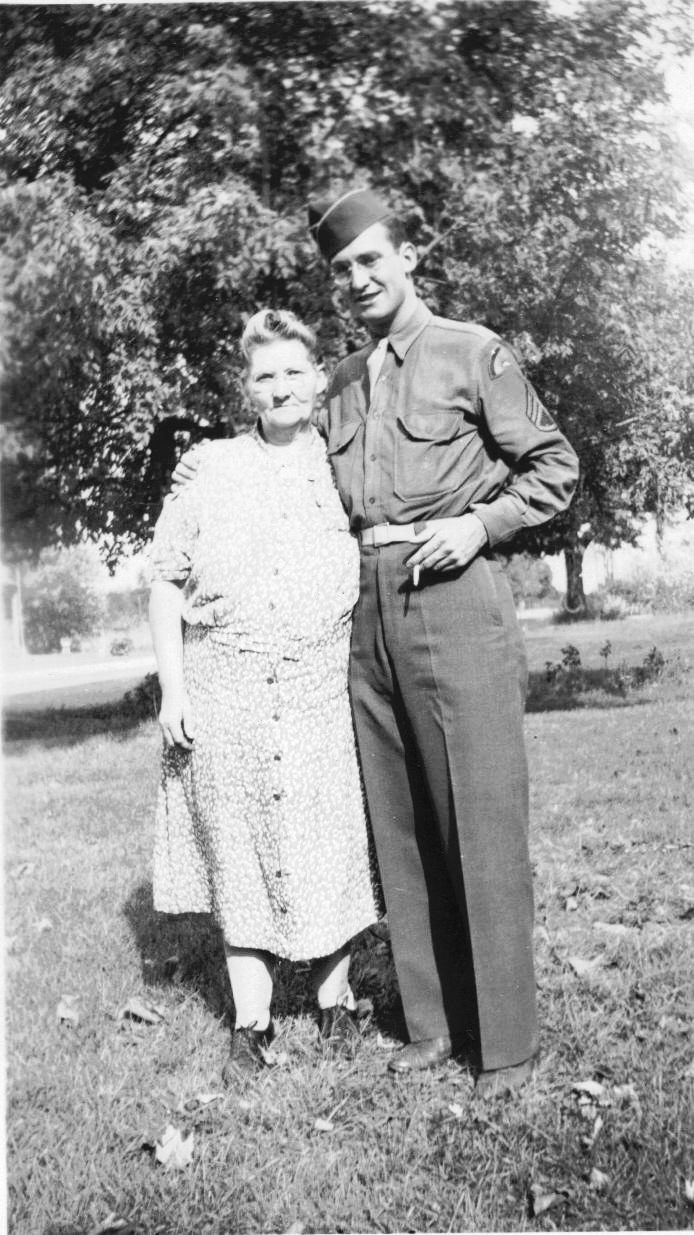
In the photograph, it is still summer.
Graydon Waters stands in the grass with his arm around his mother. She comes up to his shoulder. He is in his uniform, Rainbow patch on his sleeve, garrison cap straight, a cigarette held loose between his fingers. She is in her housedress, with its small buttons all the way down. A full tree spreads behind them. He is smiling. His mother looks straight at the camera.
This is the last photograph.
On January 9, 1945, the ground at Hatten is frozen hard and blanketed in snow and the fog sits heavy in the dark before dawn when Staff Sergeant Graydon E. Waters, son of William and Mrs. Waters of Black River, New York, climbs to a dangerously exposed position in the cupola of a Maginot Line bunker at the edge of Hatten. The battalion’s main line of resistance has been overrun by flamethrowing tanks. From the tower Graydon adjusts friendly artillery fire and puts four enemy tanks out of action. As the crews try to escape he looks down the scope of his rifle and picks them off one by one. He stays in that position, exposed, encouraging the men below him by his presence, until an artillery burst finds his position at the cupola of the Casemate Esch.
In that moment his arms, part of his head, and his life, are taken. Three witnesses carry the moment for the rest of their lives. His mother spends the rest of hers waiting for a body that if it does come home, will not come home whole. But he does not come home.
The next year, a Major pins a Silver Star to his father William’s chest at the local recruiting station. Mrs. Waters stands next to him. The photographer captures William’s face at the moment of pinning. It is the face of a man who does not know what to do with his hands, who is standing in a room that has nothing to do with his son, receiving a piece of metal where his son should be. Mrs. Waters is at the edge of the photograph, barely there, resigned at best.
Graydon’s remains are recovered from the battlefield and buried as an unknown, largely due to the nature of his remains. The years move through his family the way years do when there is a hole in the center of it all. His parents grow old carrying the not-knowing. The witnesses to his death write careful letters, trying to give the family something to hold onto, trying to place Graydon back in his body in the cupola so that his death has a shape, a location, and a final moment that belongs to him, and to his family.
Those letters from the men who watched Graydon die are now part of a formal process. Eight decades on, and his family is still actively working with the United States government to establish that the unknown in that grave is indeed Graydon. The process is slow and methodical. It moves through bureaucratic channels and asks a family to be patient about something they have already been patient about for eighty years.
The summer photograph does not change. Graydon still has his arm around his mother. She still comes up to his shoulder. He is still smiling, on a lawn somewhere in New York, before the Casemate Esch, before the artillery, before the grave with no name on it. His family carries that photograph into every space where Graydon’s name is spoken. This is the only way they can bring him with them.
•
PFC Lawrence E. Brucker
Company A, 242nd Infantry Regiment
The Village Searches
Lawrence Brucker is a small man. Five feet four inches. One hundred twenty-seven pounds. Brown hair. Brown eyes. Shoe size 5E. He is twenty-six years old. On January 8, 1945, his regiment awards him the Combat Infantryman Badge, and pins the sleek silver rifle to his chest. The next morning, the tanks come.
What he carries through the night into morning is exact, because the Army inventoried it later, when he did not come back. A fountain pen. A religious book. An almanac. A French scarf. Three portraits, folded into oilcloth to keep them dry. Four German coins from some town the Rainbow has already passed through, kept in his pocket.
He wraps the scarf around his neck against the January cold and steps out into the dark. On the morning of January 9, the Germans attack Company A. The entire company is overrun.
When the missing report is filed five weeks later, the line for Statements of Witnesses reads: None. The line for Last Known Whereabouts reads: Hatten, France. The line for Brief Resume of Circumstances reads: Entire Company overrun during attack by German forces on 9 Jan 45.
Nothing is known about how he died. Nothing.
After the battle, it is dangerous to search the fields around Hatten, because they are mined. The Army cannot search for Lawrence. As soon as the mines are cleared, the villagers search for him.
In September 1945, the mayor of Hatten writes a letter to the Army, it is not generic, it is specific to one missing American. The mayor reports that despite all efforts, they cannot locate the body of PFC Lawrence E. Brucker.
A year later, American investigators travel from Strasbourg and the village of Hatten receives them. The Americans speak with the mayor. They speak with the secretary. They speak with the forest guard, who walks the woods. They speak with the priest, who buries the dead. They speak with the postmaster, who knows every household in Hatten by name.
Five villagers. Five signatures. We have not seen Lawrence Brucker.
The Army searches German prisoner records. Nothing. They search unidentified remains and match dental charts. Nothing. They send cables and airmail and telexes and they ask for paperwork, more information, more filings. Nothing.
They cannot find him.
In May 1951, a board convenes, and one hundred twenty-eight American names go onto a list of the unrecovered.
Lawrence E. Brucker is among them.
His case is closed.
His case remains closed.
Lawrence is still in Hatten.
The village remains his keeper.
•
Staff Sergeant Solomon Feingold
Anti-Tank Company, 242nd Infantry Regiment
The Man Who Holds the Archival Line
Sol Feingold is twenty-eight years old at Hatten and he has never fired a machine gun in his life. He is a city boy who has come to a French village on the German border in the coldest winter of the war. He speaks German because his grandfather did. The Army has given him three stripes and a squad in the Anti-Tank Company, and the Anti-Tank Company has been given the streets of Hatten and a job. They are to slow the German tanks before the German tanks reach the men in the foxholes. They will do this with nine 57mm guns and a mine platoon and whatever else the cold and the burning village leave them.
The Germans are here with flame-throwing tanks and thousands of white-caped infantry against eight hundred American riflemen who have been on the line for one month.
Sol kneels in the street.
The earth has frozen so hard the ice in its divets glitters. The buildings on either side of him are burning, and the smoke meets the cold from the open street, and Sol is sweating under his jacket and shivering at the same time. Each shell that lands somewhere else in the village is a vibration up through his knees into his hips. Each shell that lands close enough is a thing he feels in his teeth. The mine in his hands is the size of a dinner plate. Inside it is a fuse and a pressure plate and a body of high explosive. The ground is too frozen to bury it. He places it on the surface of the street in plain sight. He breathes in. He breathes out. He sets the fuse. He moves ten yards down the street. He sets the next one.
He trusts the man laying the mine ten yards behind him to do his work as carefully as he is doing his own, because if either one of them flinches the line of mines breaks and the tanks come through the gap. He trusts the riflemen in the windows of the buildings on either side of the street to shoot any German who comes to clear what he has laid. Two of his men are nicked by snipers as they work. They keep working. The line of mines extends down the main street of Hatten in plain view of anyone with eyes, daisy chains of dinner plates lying on the road, and across the approaches and into the snow.
When the tank rolls down the main street toward the battalion command post, the driver sees the line of dinner plates across his road and stops. The hesitation is what Sol’s company has bought the riflemen behind him. A few seconds. A minute. Time enough for a bazooka team to find a window. Time enough for the Colonel in the cellar to keep a voice on the radio. Time enough.
The tank crew tries to clear the mines. The Germans send men forward to drag the daisy chains off the road. The riflemen of the Anti-Tank Company in the windows on either side of the street shoot them down before they reach the first mine. The tank backs up.
The Germans drive pigs down the road.
They are trying to detonate the mines without losing more men. The pigs come down the main street of Hatten, terrified, herded by the German troops behind them, hooves on the frozen road. The riflemen in the windows watch. Then they fire. The pigs are slaughtered in the street before they reach the line. The mines hold.
Sol’s German turns out to matter on the second day, when his men capture an SS officer at the intersection. The officer is twenty-two years old. He climbs out of a burning tank. Sol interrogates him in his grandfather’s language and learns the troops attacking Hatten are crack troops fresh from the Soviet front, where they had done this same work for three years, where the women had also been in the cellars. Sol writes it down, passes it up, and goes back to the streets.
The artillery comes in and fresh houses catch fire on both sides of the street. A few minutes later, Sol watches Lieutenant Richard Wells walk to the door of a house across the way and go in alone. Wells does not come back out. Sol watches the door for a long time.
When it is over, the Anti-Tank Company has lost sixty-six of their one hundred fifty-five men.
Sol goes east with his unit through Germany. On April 29, 1945, the Rainbow Division reaches Dachau and Sol walks through the gate, a liberator.
He is discharged in February 1946. He goes home to Chelsea, takes a job at the Office of Naval Research in Boston, and lives a working life. The years pass. In retirement, he begins the work that will take the rest of his days.
He fills his apartment with paper. File cabinets along one wall, then another, then in front of the windows. Photographs and letters and brittle clippings he has chased down across forty years of correspondence with mayors of small European towns.
More like a laboratory than a home, a reporter writes of the place. Sol is in his shirtsleeves. The papers are everywhere. He moves through them as though he is moving through a city he is rebuilding by hand.
He is rebuilding the record. Because the record, Sol knows, is not a thing that survives by accident. The record is a thing that survives because someone refuses to let it fall.
He is holding the line.
While researching at the National Archives in Washington, Sol opens a folder. Inside is the paperwork that says the United States Army recommended his men for the highest honor a unit can receive, fifty years earlier, and the Army did not act on its own recommendation, and his men have been dead or aging for half a century and never knew.
He takes the folder home and spends the next four years assembling the case the Army should have built in 1945. Fifteen pounds of documentation, and he calls it a labor of love, like putting a jigsaw puzzle together.
The Department of the Army issues the Presidential Unit Citation for extraordinary heroism against an armed enemy in Hatten.
Sol Feingold survived Hatten and spent the rest of his life carrying the men who did not. He lived to see the men of the Anti-Tank Company recognized, and then he kept working, because the men of B Company needed their record too, and so did the men in the cellar with the Colonel, and so did the men at the cupola, and so did the men in the foxholes, and so did the women of Hatten in their cellars beneath the burning houses.
The men gave their bodies to the village.
Sol gave his decades to the men.
When asked how he felt about the men finally receiving recognition for their sacrifice in Hatten: